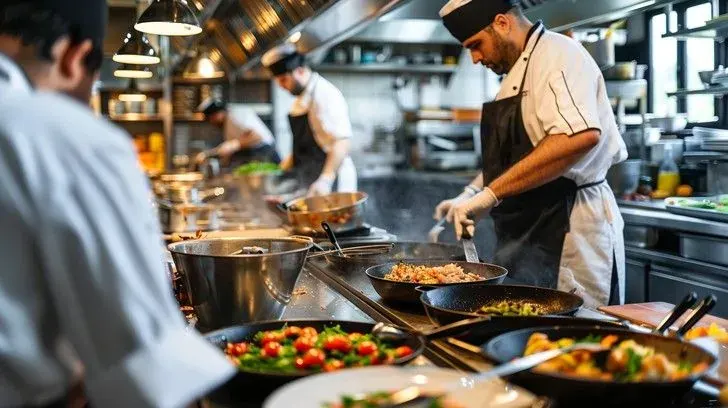
Hospitality teams prepare food for many people with different needs, often under time pressure. A buffet, banquet or room-service operation involves more than one cook: purchasing, storage, preparation and service must work together. Training helps the whole team use a shared understanding of risk.
Take food allergies seriously
A food allergy is an immune response to a food component, usually a protein. Even a small amount can cause a serious reaction in a susceptible person. An intolerance is different, but customer dietary requirements still need careful communication. Never dismiss a request as a preference without checking.
Common allergens include peanuts, tree nuts, milk, eggs, fish, crustaceans, wheat and soya. Other foods can cause reactions too, so do not treat this list as exhaustive or as a substitute for applicable labelling requirements. Read the actual ingredient information for every product. Recipes and suppliers can change.
Prevent allergen cross-contact
Cross-contact occurs when an allergen is unintentionally transferred to food intended not to contain it. Shared fryers, toasters, tongs, flour dust, utensils and poorly cleaned surfaces can be routes of transfer. Cooking does not reliably remove allergenic proteins.
Use verified recipes and ingredient labels, clean equipment effectively, separate ingredients and follow an approved allergen order procedure. Removing nuts or cheese from a plate is not a safe correction. If you cannot control the risk, explain the limitation accurately rather than promising a safe meal.
Communicate from order to service
Listen carefully, confirm the allergen and pass the information clearly to the person preparing the meal. The kitchen and service team should have a reliable method to identify the correct order. Avoid guessing whether a sauce or marinade contains an allergen.
If a customer shows signs of a serious reaction, activate the workplace emergency procedure and seek emergency medical help immediately. Do not offer diagnosis or rely on water as treatment. Staff should know how to obtain help and communicate the location.
An introduction to HACCP
Hazard Analysis and Critical Control Points, or HACCP, is a systematic approach to identifying significant food hazards and controlling them. It is supported by prerequisite programmes such as personal hygiene, cleaning, safe suppliers and pest control. Not every food business has the same legal HACCP obligations; this introduction does not claim that one generic plan suits every operation.
The seven principles are hazard analysis, identifying critical control points, establishing critical limits, monitoring, corrective actions, verification, and documentation and records. A critical control point is a step where control is essential to prevent, eliminate or reduce a significant hazard to an acceptable level.
- Identify a hazard and the control needed for the specific food.
- Monitor the control using an actual measurement or observation.
- Act when a limit is not met, then verify that the system works.
Try this in your workplace
Choose one task from your next shift and check the complete procedure: what could go wrong, what control is used and what you should do if the control fails. Discuss any uncertainty with the person in charge.
Regulatory reference: Official Department of Health R638 regulation. This article is educational, not legal advice.
Back to the journal